
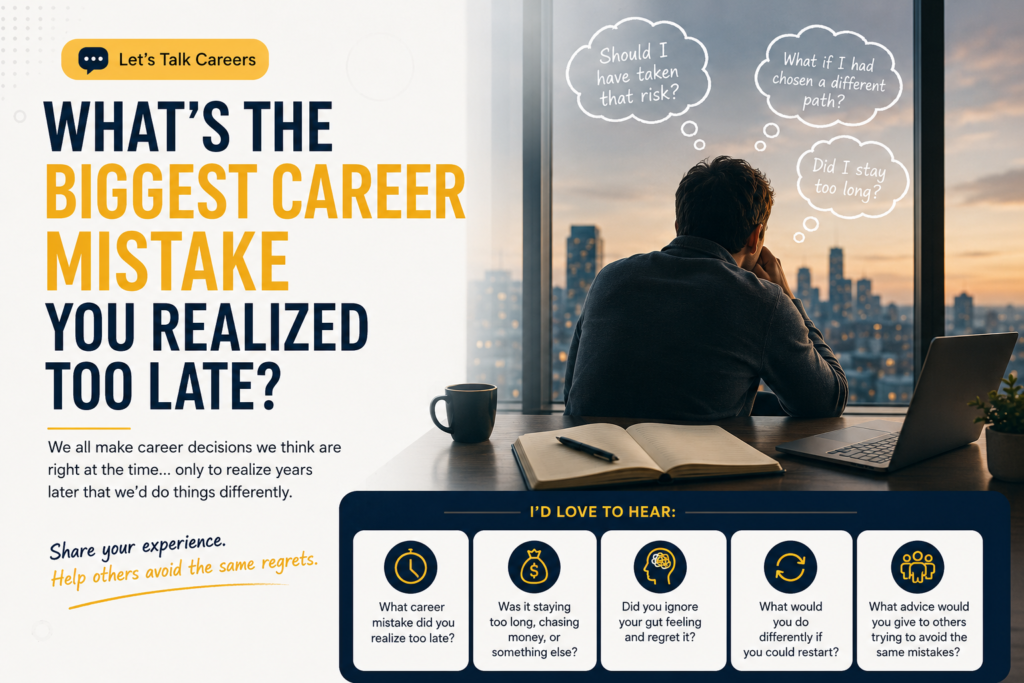

Most people don’t wake up one day suddenly hating their careers.
The feeling usually builds slowly over years.
At first, everything seems fine. The salary is decent. The job feels stable. Friends and family approve of your path. But eventually, many professionals reach a point where they start asking difficult questions:
“Did I waste too many years doing something I never truly wanted?”
“Why do I feel stuck even though my career looks successful?”
“What would I do differently if I could restart?”
These questions are more common than most people think.
Across online communities, career forums, and personal stories, the same regrets appear again and again. The interesting part is that most people only recognize these mistakes much later — often in their 30s, 40s, or even 50s.
Here are some of the biggest career mistakes people realize too late.
Staying Too Long in a Comfortable Job
One of the most repeated regrets is staying too long in the same position because it felt safe.
Comfort can become dangerous.
A stable salary and familiar environment make it easy to postpone change year after year. Many people convince themselves they will leave “next year,” but suddenly five or ten years pass.
During that time:
- Skills become outdated
- Motivation decreases
- Opportunities disappear
- Confidence drops
The problem is not loyalty. The problem is remaining in a role that no longer helps you grow.
People often realize too late that growth usually happens outside comfort zones.
Choosing Money Over Learning
A high salary can hide a bad career decision for years.
Many professionals accept jobs mainly because they pay more, even when the work itself offers little learning or long-term potential.
At first, the decision feels smart. But later, they discover something important:
Skills create long-term freedom more than salary does.
Someone earning slightly less while building valuable skills may end up with better opportunities in the future than someone who stayed in a higher-paying but stagnant role.
Money matters, but growth compounds over time.
Ignoring Gut Feelings
Many people say they sensed something was wrong early in their careers but ignored it.
Maybe the company culture felt toxic.
Maybe the work drained their energy.
Maybe they never felt excited about the field itself.
But because changing careers feels risky, they stayed.
Years later, they realized their instincts were right from the beginning.
Your intuition is not always correct, but ignoring persistent dissatisfaction usually has consequences.
Waiting for the “Perfect Time”
Another common mistake is waiting too long to take action.
People delay:
- starting a business
- learning new skills
- changing industries
- applying for better jobs
- relocating
- building side income
They wait for certainty that never arrives.
The truth is that career decisions are rarely perfectly safe.
Most successful career changes happen before someone feels fully ready.
Not Building Skills Outside Work
Many professionals depend entirely on their jobs for growth.
But today, careers move too quickly for that strategy alone.
People who invest time outside work into learning:
- communication
- writing
- marketing
- technology
- leadership
- networking
often create far more opportunities for themselves later.
Modern careers reward adaptability.
Thinking Success Means Status
Some people spend years chasing titles, prestige, or external validation.
But eventually, many discover that status alone does not create satisfaction.
A prestigious career can still lead to burnout, stress, and unhappiness if it conflicts with personal values or lifestyle goals.
Real success looks different for everyone.
For some people, it means flexibility.
For others, freedom, creativity, impact, or balance.
The mistake is following someone else’s definition for too long.
The Biggest Lesson
The biggest career mistake is often passive decision-making.
Many people drift into careers instead of intentionally designing them.
They follow expectations, fear uncertainty, or avoid discomfort until years pass without real progress toward the life they actually want.
The good news is that most careers are not permanently ruined by one mistake.
People reinvent themselves at every age.
But the earlier someone starts questioning their path honestly, the easier it becomes to change direction before regret grows deeper.
Final Thoughts
No career path is perfect.
Every decision involves trade-offs.
But the people who seem happiest long-term usually share a few habits:
- they stay curious
- they keep learning
- they adapt early
- they take calculated risks
- and they do not confuse comfort with fulfillment
The best time to rethink your career may not be someday in the future.
It might be now.